LINZER
Consulting Engineers
&
Mechanical Services
Technicians

Refrigeration, Airconditioning
mechanical Services


Refrigeration Design
and Solutions

Machine and System development
-
Thermal, Stress and Strain,
-
Fatigue vibration analysis
-
Elevated Temparature design
-
Transient Analysis and Creep Analysis.
Structural Element Analysis
-
Finite Element Analysis is a simulation technique which evaluates the behaviour of components, equipment and structures for various loading conditions including applied forces, pressures and temperatures. Thus, a complex engineering problem with non-standard shape and geometry can be solved using finite element analysis where a closed form solution is not available.
-
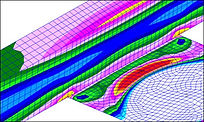
The finite element analysis methods result in the stress distribution, displacements and reaction loads at supports etc. for the model. Finite element analysis techniques can be used for a number of scenarios e.g. Design optimization, material weight minimization, shape optimization, code compliance etc.
-
3-dimensional structural analysis using Finite Element modeling for thin shells and shell structures (using shell elements where D/t ratios are relatively large) e.g. pressure vessels, tanks and associated nozzles etc. The loadings could include combinations of pressure, temperature distribution, externally applied concentrated and distributed loads.
-
3-dimensional thermal analysis (steady state thermal analysis, transient thermal analysis and thermal stress analysis) using Finite Element modeling for thin shells and shell structures (using shell elements where D/t ratios are relatively large) e.g. pressure vessels, tanks and associated nozzles etc.
-
-
3 -dimensional structural analysis using Finite Elements modeling for solid structures (using brick and tetrahedral elements where D/t ratios are relatively small) e.g. tubesheets, flanges, solid shafts, turbine and compressor components etc. The loadings could include combinations of pressure, temperature distribution, externally applied concentrated and distributed loads.
-
3-dimensional thermal analysis (steady state thermal analysis, transient thermal analysis and thermal stress analysis) using Finite Elements modeling for solid structures (using brick and tetrahedral elements where D/t ratios are relatively small) e.g. tubesheets, flanges, solid shafts, turbine and compressor components etc.
-
2-dimensional axi-symmetric structural analysis using Finite Element modeling for thin shells and shell structures (e.g. pressure vessels, tanks etc.) and for solid structures (e.g. tubesheets, flanges, solid shafts and other rotationally symmetric components etc.).
-
2-dimensional axi-symmetric thermal analysis (steady state thermal analysis, transient thermal analysis and thermal stress analysis) using Finite Element modeling for thin shells and shell structures (e.g. pressure vessels, tanks etc.) and for solid structures (e.g. tubesheets, flanges, solid shafts and other rotationally symmetric components etc.).
-
Non-linear structural analysis (using FEA software) for geometric nonlinearities and material nonlinearities. This includes Contact analysis incorporating gaps in the structures.
-
Modal analysis, Buckling analysis (non-linear buckling analysis and eigenvalue buckling analysis) using FEA techniques and FEA software.
-
Finite Elements Analysis for all above situations is performed using the state of the art software “ANSYS”.